

Remember when every AI conversation started with “Which tool should we use?“
That debate hasn’t exactly disappeared, but marketers have largely moved on.
According to Brafton’s latest survey of 163 marketers, ChatGPT remains the clear favorite tool among those who are using AI. But it’s far from the only platform teams rely on. Gemini, Microsoft Copilot, Claude and Perplexity have all earned a place in marketers’ workflows, and most respondents use more than one AI tool.
That’s a sign AI adoption is maturing.
Instead of searching for one platform that does everything, marketers are building AI toolkits, choosing different models for different tasks. It’s the same evolution we’ve seen with the rest of the martech stack: Different tools solve different problems.
The survey also found that while marketers may prefer different platforms, they’re running into many of the same opportunities — and many of the same frustrations.

ChatGPT Is Still the One To Beat
No surprise here: ChatGPT remains the dominant AI platform. Among the 132 marketers in our survey who said they’re using AI, 111 (84.7%) said their teams use ChatGPT, making it the most widely adopted tool by a landslide.
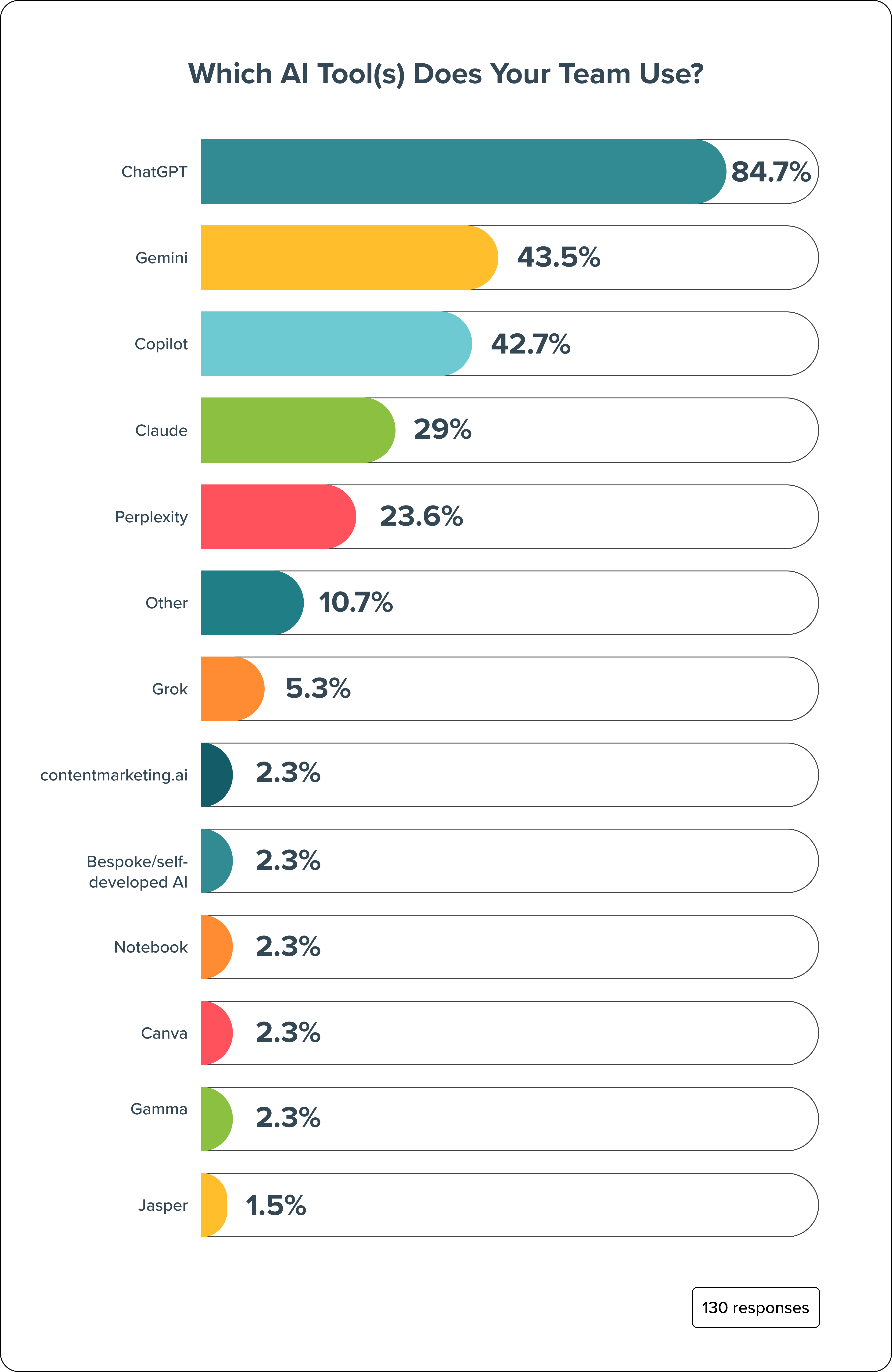
That mirrors broader adoption trends. While competition has intensified over the past year, ChatGPT remains the most widely used generative AI platform, with rivals like Gemini, Claude and Perplexity steadily gaining ground as organizations expand their AI toolkits.
But another number tells an even more interesting story. Only 23 respondents said ChatGPT was the only AI platform they use, and everyone else paired it with at least one other tool.
That suggests marketers aren’t treating ChatGPT as a one-stop solution. It’s become the starting point for many AI workflows, but not necessarily the finish line.
The platform’s popularity spans organizations of every size and nearly every industry represented in the survey, from marketing agencies and ecommerce brands to manufacturers, educators and health care organizations.
Of course, widespread adoption doesn’t mean marketers think ChatGPT gets everything right. Respondents’ biggest concerns centered on content that sounded generic, included outdated information or didn’t reflect their expertise. Many also said it could take significant editing before AI-generated content met the quality standards their audiences expect.
If you’ve ever thought, “This is a decent first draft, but it’s definitely a first draft,” you’re in good company.
Subscribe to
The Content Marketer
Get weekly insights, advice and opinions about all things digital marketing.
Thanks for subscribing! Keep an eye out for a Welcome email from us shortly. If you don’t see it come through, check your spam folder and mark the email as “not spam.”
Marketers Are Building AI Toolkits
The most interesting finding wasn’t that ChatGPT came out on top. It was how close the next tier of tools had become.
Nearly half of respondents also reported using Gemini (43.5%) and Microsoft Copilot (42.7%), while Claude (29%) and Perplexity (23.6%) rounded out the top five.
ChatGPT was the clear leader, and the next four tools clustered surprisingly close together. Rather than gravitating toward a single “challenger,” marketers appear to be experimenting with multiple platforms.
Perhaps the clearest sign of that shift is that almost nobody relied on those tools alone. Only two respondents used Gemini by itself, six used only Copilot, and no one reported using Claude or Perplexity as their sole AI platform.
That paints a very different picture than “Tool A is beating Tool B.” Instead, marketers are building AI toolkits, combining platforms based on their strengths rather than searching for a single solution that does everything well.
AI researcher Ethan Mollick offers a useful reminder for anyone evaluating today’s AI landscape: “Assume this is the worst AI you will ever use.” The marketers in our survey seem to be taking that advice, experimenting with multiple tools as new capabilities emerge.
The survey didn’t ask respondents why they chose specific platforms, but the pattern aligns with broader industry trends. ChatGPT has become the general-purpose workhorse, Copilot integrates naturally into Microsoft 365, Gemini fits Google’s ecosystem, Claude is known for handling longer documents and nuanced writing, and Perplexity has become a popular research assistant with cited responses.
Whether marketers use these tools exactly these ways will vary from team to team, but the broader trend is clear: AI workflows are becoming more specialized. Rather than asking, “Which AI tool is best?” marketers are increasingly asking, “Which AI tool is best for this job?“
Different Tools, Same Challenges
While marketers may have different favorite AI tools, their biggest frustrations are remarkably consistent.
Across every major platform, respondents pointed to the same issues: generic content, outdated or incorrect information, outputs that didn’t reflect their expertise and drafts that still required more editing than they’d like.
The biggest complaint by far was content that sounded thin or generic, but that shouldn’t come as much of a surprise. Generative AI is exceptionally good at recognizing patterns in language. It’s much less reliable when it comes to producing original perspectives, industry expertise or the kind of nuanced thinking that builds trust with an audience. That’s also why editing remains such an important part of the process.
AI can help marketers move past a blank page, organize ideas and generate first drafts much faster than before. But our survey suggests most teams still rely on human expertise to shape those drafts into something that reflects their brand, their experience and their audience’s expectations.
Interestingly, those challenges didn’t seem tied to one platform over another.
Whether respondents preferred ChatGPT, Gemini, Copilot, Claude or Perplexity, they reported many of the same pain points. That suggests marketers aren’t dealing with a ChatGPT problem or a Claude problem. They’re navigating the realities of generative AI itself.
The good news is that those limitations don’t appear to be slowing adoption. Instead, marketers seem to be adjusting their expectations, treating AI as a collaborator rather than an autopilot.
Budget doesn’t appear to be a major barrier, either. Across every major platform, most respondents reported having either a small AI budget or relying entirely on free versions of the tools. That suggests marketers are finding practical ways to experiment with AI without waiting for enterprise-level investments.
The impact data tells a similar story. Regardless of which AI platform marketers preferred, the biggest benefits were consistent: getting work done faster and getting more work done overall. Improvements in quality and cost savings ranked lower, suggesting AI is currently helping teams increase capacity more than replace work.
The Real Value of AI Isn’t Cutting Costs — It’s Creating Capacity
One finding stood out regarding AI platforms. Regardless of whether marketers preferred ChatGPT, Gemini, Copilot, Claude or Perplexity, they reported remarkably similar outcomes.
The biggest benefit wasn’t reducing costs or replacing work. It was getting work done faster.
Across every major platform, “We get things completed faster” ranked as one of the top responses, closely followed by “We’re doing more things with AI.”
That’s an important distinction.
Much of the public conversation around AI focuses on automation and efficiency. While those benefits certainly exist, marketers in our survey appear to be using AI to expand their capacity rather than shrink their workload.
Instead of replacing strategic work, AI is helping teams move through repetitive tasks more efficiently, generate first drafts, summarize research and organize information more quickly.
The budget data reinforces that idea.
Most respondents reported having only a small budget dedicated to AI tools, while many rely entirely on free versions. Only a relatively small percentage described AI as a core component of their martech stack.
That suggests meaningful AI adoption doesn’t necessarily require a major technology investment. For many teams, success has come from learning how to use a handful of accessible tools well rather than buying every new platform that hits the market.
Taken together, the findings point to a more practical view of AI. The biggest return isn’t necessarily spending less, but creating more time for the work marketers value most — strategy, creativity and problem-solving.
What This Means for Marketing Teams
The survey makes one thing clear: The AI conversation has changed. Marketers aren’t asking which platform will replace every other tool on their desktop. They’re figuring out which one fits the task in front of them.
That’s a sign AI is becoming less of a novelty and more of a standard part of the marketing workflow.
The platforms will continue to evolve. New competitors will emerge. Today’s favorite tool might not hold the top spot forever.
But one thing seems unlikely to change: AI still works best when paired with human judgment. The marketers getting the most value from these tools aren’t simply generating more content; they’re asking better questions, evaluating outputs critically and knowing when AI has taken them 90% of the way — and when it’s time to take over.
Because eventually, every marketing team will have access to powerful AI tools. Knowing which one to use, and when not to use one at all, may be what sets the best teams apart.