
You’ve taken the time to capture customers’ attention and signed them up for your email newsletter. This is a great way to keep in contact with your audience so they remain attentive and loyal. Inevitably, however, some of those email subscribers will lose interest and stop interacting. What then?
When business-as-usual communications like email newsletters aren’t working like they used to, it’s time to cook up some content specifically designed to get inactive subscribers’ eyeballs back where they belong: on your brand.
It’s time to send a re-engagement email.
The exact form of your re-engagement email will differ depending on whether you’re a business-to-consumer (B2C) or business-to-business (B2B) company, as well as the interests and preferences of your unique audience. The overall goal is always the same, however: Re-engagement emails are meant to reinvigorate a customer connection that has lost its spark.
Why it’s important to re-engage inactive customers
Inactive customers represent a significant, often overlooked opportunity for growth in your email marketing strategy. These are individuals who were once interested enough to subscribe or engage, but have since become dormant. Re-engaging these contacts can help you:
- Maximize your acquisition investment: You’ve already invested time and resources to acquire these subscribers. Re-engagement emails give you a second chance to realize value from that investment without the higher costs associated with acquiring brand-new leads.
- Improve email deliverability and sender reputation: High numbers of inactive subscribers can impact deliverability rates. By targeting and either reactivating or removing these contacts, you ensure your emails are reaching genuinely interested recipients.
- Boost revenue and ROI: Inactive customers are often easier and less expensive to win back than to convert brand-new prospects. Even a small percentage of reactivated subscribers can lead to a noticeable lift in revenue and campaign ROI.
- Gain actionable insights: Re-engagement campaigns allow you to better understand what content, offers or timing resonates with your audience. The responses (or lack thereof) provide valuable data for refining your email marketing strategy.
- Maintain a healthy list: Regularly reaching out to and managing inactive subscribers helps keep your email list clean, engaged and compliant with industry best practices.
Re-engaging inactive customers is about maximizing the value of your entire audience, maintaining strong deliverability and driving long-term growth through more targeted email marketing efforts.
Email Re-Engagement: What It Is and How It Works
Every company that engages directly with its customers hopes that those customers will respond in kind, clicking through links, reading every email subject line and coming back to shop with the business again. Re-engagement emails are for the other customers.
The targets of re-engagement messages may have subscribed to a mailing list, but stopped opening, clicking or replying — classic signs of declining subscriber engagement. Or they might have started making an e-commerce purchase but didn’t finish it, leaving an abandoned cart behind. Companies use a re-engagement email campaign to shake up the normal communication cadence and turn at least some of these disengaged customers and dormant subscribers back into active participants.
Businesses can reach out with special offers, new subscription options, exclusive content or a multi-step engagement email sequence that rekindles curiosity. At best, they’ll create engagement without the extra effort and cost that goes into finding new leads, helping to win customers who were on the verge of churning.
Even if the email campaign doesn’t work, the company has gathered useful intelligence about what customers are interested in and which types of engagement emails resonate. This is a source of knowledge marketers shouldn’t take for granted. The Content Marketing Institute asked B2B marketers about the metrics that provided insight into the overall performance of their content. Nearly two-thirds, 64%, said email engagement is a useful indicator.
Remember: Some Disengagement Is Natural
Before getting started on a re-engagement email strategy, it’s important to acknowledge that you can’t bring everyone back. Flodesk pointed out a few legitimate reasons why unengaged subscribers stop interacting with brands:
- The passage of time has changed the customers’ circumstances, and the products aren’t relevant anymore.
- Customers are connecting with the company through another channel and are ignoring email.
- Subscribers simply want fewer marketing emails, so they’re not engaging with as many companies anymore.
In these cases, it’s better to simply cull those lapsed subscribers from the mailing list, therefore making the email list a more accurate representation of engaged customers and protecting your sender reputation.
However, as Flodesk added, there are cases when a brand can change up its tactics and win inactive subscribers back. This is where re-engagement emails shine.
How Re-Engagement Works
Re-engagement emails break up the normal cadence of communication, serving as a refreshing departure from something that isn’t working. They are designed to speak directly to a customer’s interests, so that person will return to the fold. There are a few types of re-engagement tactics, each with its own approach:
1. Encouraging a Customer To Complete an E-Commerce Transaction
Cart abandonment in e-commerce is a major problem. Fresh Relevance found in its Q2 2021 report that customers abandon their carts at a rate of 59.2%. Immediately following up with these shoppers through an automatic engagement email — the first touch in a broader engagement email sequence — can win some of them back. Maybe they forgot about the items, or perhaps the message will remind them why they wanted it in the first place.
2. Re-Engaging an Inactive Subscriber
Has a customer signed up to receive emails from your company but not engaged with the links in those emails? In that case, it’s time to launch a more thorough engagement email campaign, compared to an abandoned cart email. It could begin with a direct question about whether the person wants to keep receiving emails, an offer to modify subscription settings, a showcase of fresh email examples that match their interests or a free gift or coupon to spark effective engagement.
3. Deepening an Interaction With a Customer
Not every re-engagement campaign is about winning over a customer who has stopped communicating with a brand. Sometimes, it’s beneficial to be proactive and ask follow-up questions of someone who has clicked a link in a previous email. This is a way to gather feedback, enrich your data and keep the company top of mind — a kind of preemptive effort to prevent disengagement.
While each of those objectives is different, the approach to achieving them is basically the same: The company sends a well-crafted email outside of its normal pattern and, ideally, gets a response.
Due to the prevalence of modern marketing automation platforms, there is not much overhead associated with sending emails. This means email re-engagement can be a low-risk tactic that yields potentially great rewards, particularly when compared with the cost of acquiring brand-new leads.
Examples of Successful Re-engagement Emails
Re-engagement emails work when they earn attention. This is broadly true of any email communication, but when it comes to re-engagement, awareness is absolutely critical. The email subscriber or e-commerce customer in question hasn’t been doing something the company wants, so this new message is designed to bring them back before their attention wanders further. The following engagement email examples show how brands have used sharp email subject lines, thoughtful incentives and clever copy to reclaim inactive customers:
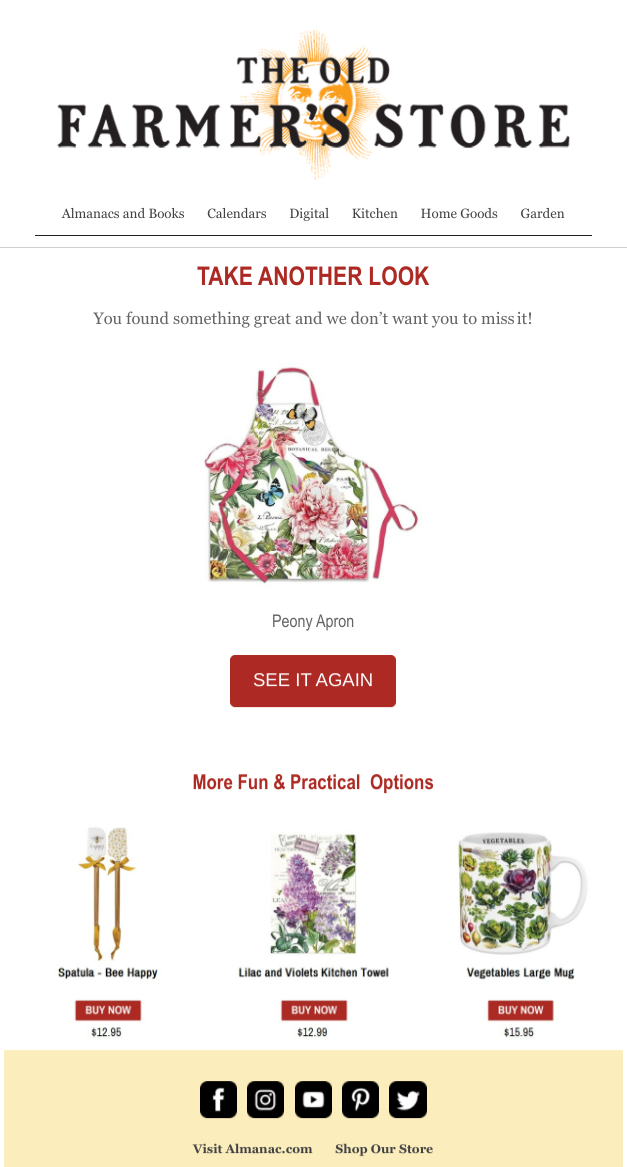
The Old Farmer’s Store
- The situation: The company sent an email recommending aprons in its e-commerce store. The recipient clicked on one of the aprons to learn more, then didn’t follow through on buying it.
- The response: A few hours later, The Old Farmer’s Store sent a second email, this time directly asking the shopper to “take another look” at the apron in question with the subject line “We love what you found.”
Craftsy
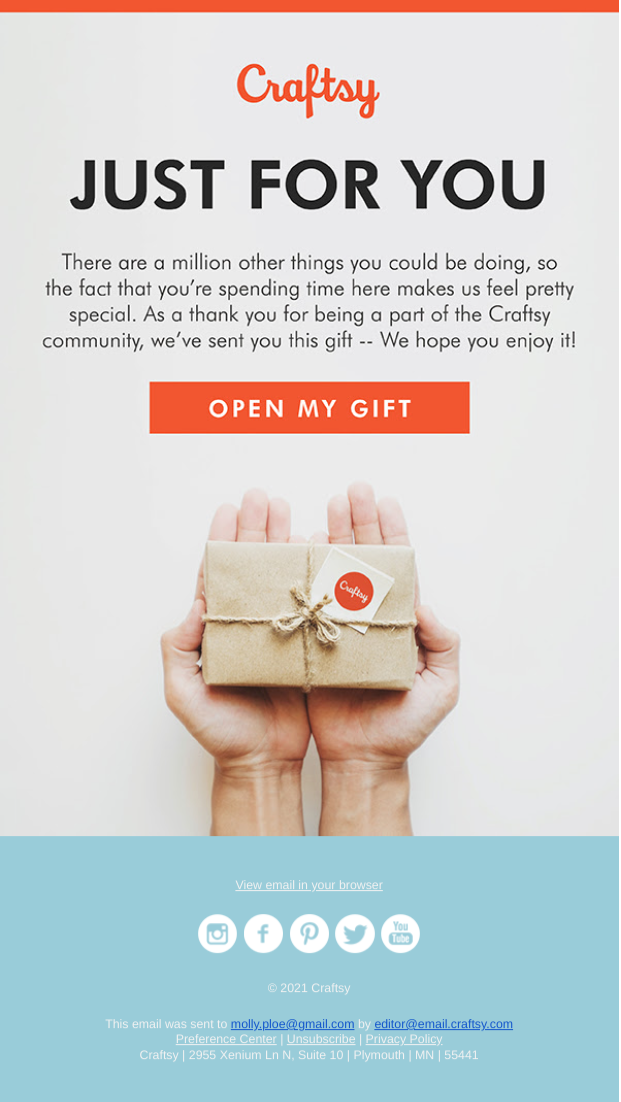
- The situation: A customer was browsing the Craftsy website, but didn’t engage with the company’s services, likely due to an unwillingness to pay the listed price.
- The response: The site sent out a re-engagement email saying that the customer’s browsing “makes us feel pretty special,” and included a discount code — a textbook effective engagement strategy that uses savings to win customers back.
Xero Shoes
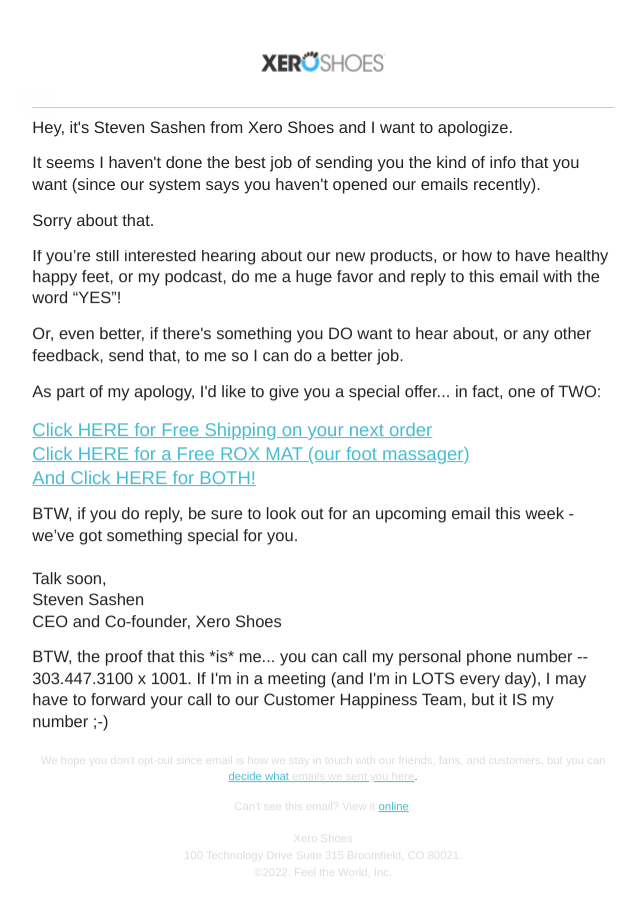
- The situation: A shopper signed up for the Xero Shoes newsletter but did not purchase any products from the company.
- The response: Xero’s re-engagement email combined an eye-catching engagement email subject line (“my apologies… :-(“) with two different discount offers, as well as the honest admission that the company was sending the email because the subscriber had not read its recent emails — a perfect example of creating engagement email authenticity.
The messages in each email example are designed to work on a different time frame, and they offer a range of enticements to encourage re-engagement. The first represents a quick hit to keep a transaction going, while the latter two are customer appreciation emails designed to drum up business with discounts and offers. The third combines that appeal with the must-click factor of a bold email subject that sparks curiosity.
By mixing and matching email marketing strategies, companies can turn all types of situations into opportunities to re-engage customers, nurture subscribers’ engagement and build their own email success stories.
Best Practices for Email Re-Engagement
Creating a re-engagement email is not the same as crafting a standard newsletter blast. After all, the objective of a re-engagement campaign is to get a different reaction than what the recipient has shown so far. That means the business has to switch up its approach to reclaim customers’ attention and achieve effective engagement.
What are some tactics that can elevate a re-engagement email and get results?
- Don’t send anything without a compelling headline: As Industrial Marketer pointed out, the headline — or to be precise, the email subject line — of a re-engagement email is essentially the most important part. Without a subject that encourages a click, the actual content of the message won’t be read and, as such, is meaningless. Industrial Marketer suggested being professional and straightforward in B2B spaces, with B2C campaigns leaving more room for emotion, such as saying “I miss you” directly in the text.
- Pick your moment to follow up: How long is long enough to wait for a customer to respond or act before you send engagement emails? According to GetResponse, it depends on what type of action you’re looking for from the recipient. For example, more than 50% of emails will be opened within 6 hours, so if a company is running a limited-time promotion, the 6-hour mark is a fine moment to reach out to inactive customers who haven’t acted yet. In longer-term scenarios, GetResponse recommends waiting a day or more, or simply not responding in all cases. Not every disengagement demands an immediate re-engagement.
- Use what you know about customers: There is one tactic that applies to all forms of email marketing — leveraging data to deliver relevant content. Effective engagement emails are based on audience segmentation, giving offers and recommendations that will resonate with segments of the customer base. Re-engagement campaigns should be the same. Impersonal or irrelevant email blasts aren’t appreciated the first time around, so they don’t stand much chance of winning over a disengaged subscriber.
A successful re-engagement campaign uses key features of email marketing — including sharp email subject lines, well-timed delivery, persuasive copy and personalised offers — to maximise subscribers engagement. It simply dials these approaches up to ensure the messages are especially compelling and able to serve their purpose within a broader email sequence.

How We Use Re-engagement Tactics in Email Campaigns
As a content marketing agency, Brafton has helped clients design a variety of email campaigns, and these include specialised engagement email campaigns focused on winning back inactive contacts. The following are a few specific tactics we’ve employed to reconnect companies with their customers across a variety of industries and scenarios:
1. Quick Follow-up for Feedback
This approach applies when a customer has clicked through to a piece of content, such as an eBook they requested. It asks for a customer opinion on the deliverable, creating a two-way dialogue that fuels effective engagement. That, in turn, is a good prompt to gather some insights from the recipient. Additionally, if they haven’t looked closely at the content, it could encourage them to check it out.
2. Unopened Email Follow-up
A more direct form of re-engagement than a follow-up to an opened email, this line of action is basically a do-over. When a customer has engaged with content in the past but not checked out a recent message, this is just a reminder to take a look.
3. Direct Request for Reply
If a company is looking for a specific response from a client who has been out of touch for a while, sometimes the best approach is to be direct. Rather than a marketing email with links to click on, the business can send a concise yet effective engagement email asking the recipient to write back directly, thereby cementing a personal connection.
4. Newsletter Email Subscriber Survey
This type of email can re-engage people who have not been interacting with scheduled newsletters. It gives them a chance to voice their opinions about what they would like to see differently in the future, helping you create engagement and tailor future sends to their preferences.
5. Straightforward Re-engagement Campaign
When a customer has been out of touch for a while, the best way to check in can be via an email that asks, right in the subject line, whether that person still wants to receive messages. If they say yes, it’s a direct re-engagement with the brand, and if not, it’s a sign to cull a lapsed customer. In either case, the recipient may appreciate that the company is giving a chance to opt out, not clinging, which ultimately safeguards your sender reputation.
6. New Subscription Type Offer
A variation on the newsletter subscriber survey, this kind of email gives customers the chance to subscribe to a new and different newsletter from the same sender. It’s a good tool for reaching once-active subscribers who have recently not been as responsive.
7. Giveaways and Offers
A little incentive can be just what a customer needs to take a second look at a company. Of course, the giveaway or coupon should have value and be tied to the recipient’s interests, or else it will end up seeing the same fate as all the other communications the customer has been ignoring. When done right, a discount-driven email can win inactive subscribers and turn them into vocal brand advocates.
These are just a few of the re-engagement tactics available. Any company can set its own terms of engagement, based on what matters to that business. Cart abandonment, a lack of engagement, a change in account status — any trigger can earn an email response.
As long as a company has accurate customer data, a well-thought-out email marketing strategy and the technology to support its efforts, there’s nothing stopping that business from creating engagement emails that revive relationships with inactive subscribers. Next time you’re worried about your own audience slipping away, ask yourself if there’s a message that could lure people back.
Editor’s note: Updated in February 2026