
Over the past decade, blogs have become so central to digital marketing that it’s hard to imagine a world without them. They don’t just display words on a page — they drive potential customers to your website, build brand awareness, demonstrate industry authority and act as launch pads for further engagement with every content type you create.
But if you approach blogging without a well-thought-out content strategy plan, you might as well be shouting into the ether. Today, that plan must also recognize how search engines, AI Overviews and large language models surface and distribute content. Let’s take a look at what it takes to create, execute and continually optimize content for a successful blog strategy in 2026.
How Blog Strategy Has Changed in the AI Search Era
Search has evolved from ten blue links to an experience where AI Overviews, answer boxes and conversational chatbots often appear before traditional organic results. That shift has profound implications for every marketing content strategy:
- AI Overviews shrink click-through windows. When Google or Bing presents an instant answer, users may never scroll. Your mission is no longer just to rank — it’s to be cited inside those AI answers.
- Topic authority beats isolated posts. Search engines reward publishers that build content clusters demonstrating breadth and depth, signalling that you can effectively create content and optimize content around a holistic theme.
- Geo-specific nuance matters. Generative search pulls from region-specific sources; therefore, you must create content that reflects local terminology, regulations and user experience expectations.
- Sustainable execution requires a strategy plan. Teams of content strategists now map pillar pages, cluster posts and distribution cadences so they can execute content strategy at scale while aligning with business goals.
With that context in mind, let’s learn the steps to an effective blog strategy in 2026..
Step 1: Document Everything About Your Content Strategy
“Wait a minute,” you may be asking, “how can I document a content strategy that doesn’t exist yet?” Fair question. OK, so this isn’t exactly the first step in the process. But from the outset, you need to be sure that you’re creating a complete record of your strategy to follow and refer back to. In 2026, that documentation also doubles as a living blueprint that feeds your AI optimization workflow, content governance framework and cross-channel distribution plan.
Even if you regularly hold stakeholder discussions with content creators, strategists, marketers, analysts and other team members, you’re doing yourself a disservice if you don’t document your content strategy. Today, that documentation is also the data source that lets AI tools evaluate performance, suggest ways to build content faster and highlight gaps across the customer journey.
So, what should you document? Here are a few major items to keep track of:
- Content marketing goals.
- Past, current and planned campaigns mapped to a clear content strategy plan.
- Editorial or content calendars with publishing cadence by content type.
- Metrics for campaigns, promotions and individual blog posts.
- A/B testing results, plus AI-generated insights you intend to execute.
Documenting your blog content strategy should become second nature, like muscle memory. Want to see which types of headlines and topics resonate with your target audience or drive the most traffic to your website? Or investigate why some campaigns flourished while others landed flat? You have the records and data to figure that out — and now you can push those insights directly into AI tools to automatically optimize content and distribute content across multiple channels.
Content marketing is a constantly shifting undertaking, and combining historical results with current data will help you stay ahead of trends, fine-tune user experience and maintain success down the road.
Step 2: Give Your Blog a Clear Objective
Before you get into the nitty-gritty of creating a blog content strategy, you need to nail down precisely what you hope to achieve with your website’s blog. This type of marketing content can serve a variety of purposes and goals, from boosting brand awareness to nurturing leads. Having a clear sense of your marketing objectives before you start building out a blog content strategy will help you make the best decisions for both overarching campaigns and individual blog posts.
Consider these possible uses for blog content:
- Driving more traffic to your site.
- Converting site visitors to qualified leads.
- Updating existing customers about company news and product releases.
- Teaching prospective customers about your product offerings and services.
- Telling your brand story.
A blog can do one or all of those things, and it’s important to have a strategy plan of action from the outset. In 2026, many content strategists map each objective directly to a pillar page or cluster so that both humans and search engines understand how every new piece of content ladders up to broader business goals.
Your content objectives will also inform what metrics you should be tracking and prioritizing. If you simply want to get more eyeballs on your site, then measuring organic traffic and page views will tell you if you’re hitting the mark. Of course, you have to dig deeper to get a more nuanced understanding of the way site visitors are responding to your content. For instance, comparing raw page views with bounce rates and click-through rates (CTRs) will show you how many people leave your site immediately after viewing your blog and how many stick around to check out other pages on your site.
Step 3: Decide What Content Will Live on Your Blog
Obviously, you’re going to populate your blog page with blog posts, but what about other types of content? Many brands use their blog pages as catch-all content repositories, mixing news articles with case studies, customer testimonials, press releases and other posts. This approach isn’t always advisable since visitors need to take extra steps to find the content they’re interested in (for instance, filtering out company updates and promotional content). You want to make it as easy as possible for audience members to find the content they want.
A more structured approach that devotes dedicated pages to blogs, case studies and downloadable assets, among other types of content, will also make it easier for your marketing team to track their performance. You can better understand the user journey and what steps people take on their way to conversion.
Today, most organizations also maintain a living inventory of existing content so they can quickly see gaps, avoid duplication and decide when to build new content or re-optimize older assets for fresh performance.
Step 4: Define Your Blog Audience
Writing blogs without a clearly defined audience is like going for a drive without a destination. You may get where you need to go, but it will be purely by accident, and you’ll waste a lot of time, energy and money in the meantime.
Every blog you post should target a specific subset of your audience, covering the subjects that matter most to those individuals and sharing meaningful insights and guidance that will leave the biggest impact. Hopefully, you already have a list of detailed buyer personas, influencers and other key audience segments. If not, then put your blog writing on hold until you have those audience profiles fleshed out.
We’ve got a few detailed persona guides to help you define your different audience profiles, but here’s a quick primer to get you started:
- Gather data about your audience using Google Analytics, your customer relationship management (CRM) platform and other data sources.
- Figure out your audience’s major needs, challenges and pain points.
- Identify what different customer segments prefer to read about, so you can tailor your messaging and content to fit their preferences.
- Compile audience profiles according to different demographics, psychographics (e.g., likes, dislikes and core values), pain points, preferred channels and ideal content types.
With this info in hand, you can tailor every blog to a particular audience segment and give that content a specific purpose. That nuance not only improves user experience but also helps search engines connect your content to queries with higher intent.
Take this article, for example. Would a content creator or CEO need to know about creating a blog content strategy? Probably not. But for all the digital marketers out there, this guide should be extremely helpful (fingers crossed). This one’s for you.
Step 5: Research the Market and Competition
With your audience personas defined, you can start sorting through the type of content they’ll find most valuable. It never hurts to look at your competitors to see what’s working for them and what you can replicate on your own site.
Just as importantly, where are there gaps in the competition’s blog content strategy? There could be key topics or content pieces your business rivals have neglected, giving you a perfect opportunity to gain an edge in the ongoing digital marketing battle.
Not sure where to start? There are plenty of content marketing platforms out there to help you conduct market and competitor research, identify potential keywords and brainstorm specific topics. Semush, for example, offers a number of competitor analysis tools to help you figure out what pages are drawing in the most traffic to your rivals’ sites, what keywords they’re ranking for and where you can fill in the gaps. Increasingly, content strategists also look at which competitor pages are being cited in AI Overviews — a shortcut for spotting authoritative content that earns visibility without traditional clicks.
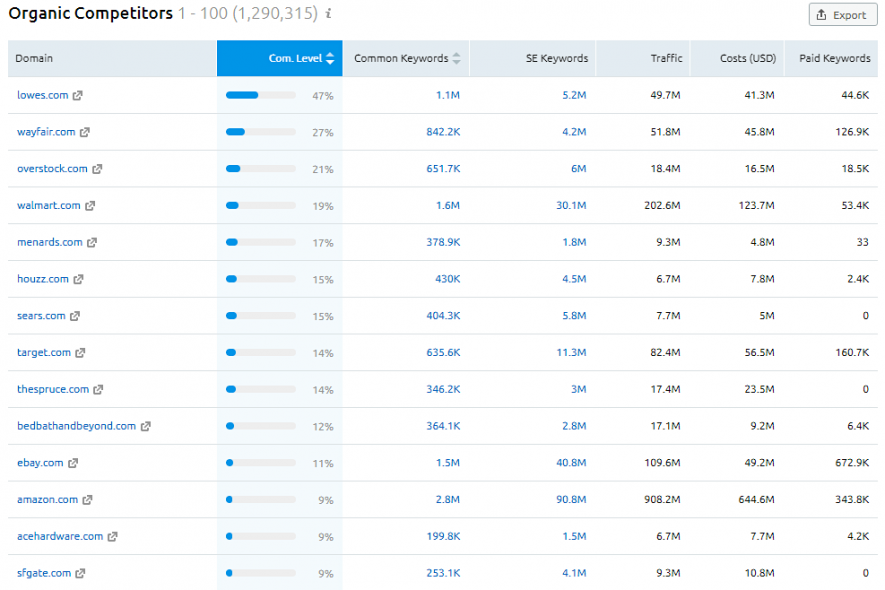
Even if you’re not 100% sure who all of your main competitors are beyond the top few, conducting market research with the help of these types of tools should clear things up for you.
Step 6: Conduct Keyword Research
Now that you have your audience personas, competitor analysis and market research, you can really dig into the search engine optimization (SEO) component of your content marketing strategy. Using those same content marketing tools, begin sketching out keywords you want to target in your blog content strategy. Whether or not generating organic traffic is a primary goal for your site’s blog, you still need your pages to rank high on search engine results pages (SERPs) so people can actually find your content.
Of course, just landing on the first page of search results is no guarantee that people will make their way to your site these days. The No. 1 result on the Google SERP has an average CTR of 27.6%, but the organic CTR for positions 8-10 is virtually identical. That means a small ranking increase may not lead to a significant click increase. (And even the No. 1 spot doesn’t guarantee clicks thanks to AIOs, but more on that in a minute.)
Your best bet is to focus on the right keywords for your niche. Building out a list of targeted keywords gives you plenty of inspiration for blog content, especially if you ever experience writer’s block or feel like the creative well has run dry. Semrush, Moz, Ahrefs and other content marketing tools can also point you toward relevant search queries related to your primary keywords so you can expand the scope of your blog content strategy or hit multiple high-priority phrases in the same blog post. By doing so, you not only create content that appeals to human readers but also optimize it for search engines and AI systems that thrive on semantic richness.
GEO and AI Overviews: How Keyword Strategy Has Changed
In 2026, classic keyword difficulty scores only tell half the story. You also need to consider:
- Geographic nuance: Search engines personalize results by country, city and even neighborhood. When you create content strategy blueprints, map primary and secondary GEO targets so you can tailor terminology, regulations, cultural references and internal linking accordingly.
- Answer-friendly phrasing: AI Overviews and voice assistants prefer concise definitions and structured data. Choose keyword variations that are easy for algorithms to summarize, then place those phrases in headings, FAQs and list items.
- Topical completeness. Search engines reward publishers that cover every sub-topic a user might explore. Build clusters around your pillar page so you can distribute content that collectively answers each related question.
- Citation potential. Modern keyword research also weighs how likely a piece is to be cited by AI. Authoritative statistics, first-party data and expert quotes increase your odds of earning those coveted citations, even if a user never clicks through.
Be Realistic About Your Keyword Prospects
In a perfect world, every search query would be up for grabs, with quality content separating the top performers from other results. The reality is there are keywords brands will never rank for, including phrases that closely align with their services and offerings. The competition is just too fierce to break through with keywords dominated by market leaders.
When conducting keyword research, always keep the level of competition in mind so you can devote your time and resources to queries for which you have a real shot at reaching the top few SERP positions. Effective keyword analysis requires a constant balance between search phrases that are relevant to your business, meaningful to your audience and attainable as ranking targets.
Increasingly, content marketers need to account for on-SERP SEO when building out their keyword lists and devising blog strategies to target those search queries. With above-the-fold results like featured snippets, image carousels and answer boxes gobbling up impressions, brands have to contend with even more competition for search engine users’ attention. That’s why many marketing content strategy teams prioritize keywords with strong “answer box” potential as well as those that align with their broader cluster.
Your content marketing team should look beyond the raw data provided by SEO and keyword analysis tools and review SERPs for each keyword you have in your sights. Assess the layout of those SERPs, using heat maps if possible, to set realistic expectations. Do the featured snippets, answer boxes, knowledge graphs or other above-the-fold results provide the information users want? Are they likely to even look beyond that content at the top few organic search results?
Take these extra steps up front to avoid wasting time writing blogs and chasing keywords that will never deliver the results you want.
The Modern Blog Structure: Topic Clusters and Pillar Content
High-performing blogs in 2026 rarely rely on stand-alone articles. Instead, they create interlinked webs of content that establish domain-level authority. Welcome to the era of topic clusters.
What Is a Pillar Page?
A pillar page is an in-depth, authoritative resource that comprehensively covers a broad subject — think “everything you need to know about blog strategy.” It’s designed to rank for competitive terms and acts as the anchor that connects readers (and crawlers) to more granular subtopics.
What Are Cluster Posts?
Cluster posts are supporting articles that target specific long-tail queries related to the pillar theme — for instance, “how to create content calendars for a B2B blog” or “best content types to nurture potential customers.” Each cluster post links back to the pillar page and to other clusters where relevant, creating a robust internal linking architecture that helps search engines understand topical relationships and user pathways.
Why the Cluster Model Wins in 2026
- Authority signalling: Search engines gauge breadth and depth to judge expertise; clusters demonstrate that your brand can build content ecosystems, not just isolated posts.
- Better user experience: Visitors can easily navigate between related resources, extending session duration and improving engagement.
- Scalable execution: Content strategists can create, track and optimize clusters incrementally, ensuring every new piece supports the overall marketing content strategy.
- AI visibility: AI Overviews prefer citing authoritative sources that cover an entire subject end-to-end; clusters make that coverage explicit.
How To Plan Your First Cluster
- Identify the pillar topic: Choose a theme that aligns with your business goals and has enough search demand to justify investment.
- Audit existing content: Catalog existing content that can be refreshed, consolidated or expanded; this shortens production cycles and helps you optimize content efficiently.
- Map subtopics: Use keyword research to outline 8-15 supporting articles that answer every key question about the pillar theme.
- Create content & refresh simultaneously: Develop net-new assets where you have gaps and re-optimize older posts that can be updated with fresh data or examples.
- Interlink and monitor: Once published, build internal links from each cluster post to the pillar page (and vice versa) and track performance weekly with your analytics platform.
Example: Full Mapped-Out Cluster
- Pillar: Blog Strategy 2026 — The Ultimate Guide
- • Cluster 1: How To Build an Editorial Calendar That Maps to the Buyer’s Journey
- • Cluster 2: 15 Blog Content Ideas That Convert Potential Customers
- • Cluster 3: Step-by-Step Content Audit Template for Existing Content
- • Cluster 4: Optimize Content for AI Overviews and Voice Search
- • Cluster 5: Distribute Content Across Social Media and Email Marketing
Step 7: Establish Your Blog’s Voice
Every blog needs a strong point of view, especially when commenting on industry trends and developments. It’s just as important to create a distinct voice for your blog so every post reflects your brand and messaging.
Your blog’s voice is an extension of your brand, so take the time to define what exactly that entails. It’s important that you tailor your style and tone to your target audience’s expectations and preferences. A light and irreverent tone might resonate with some consumer audiences, but it could come across as glib if you’re speaking to the financial services crowd about year-end audits or SEC regulations.
Here are a few different approaches to brand voice:
- Empowering and uplifting.
- Friendly and informative.
- Professional and ambitious.
- Goofy and even downright weird.
Regardless of which path you choose, you don’t want your blog to be too stuffy or dense. Blogs need to be readable, after all. If you bog people down in a lot of jargon and endless walls of text, they’re going to tune you out. In 2026, readability also means structuring your paragraphs so that machine summarization tools can effortlessly extract key insights and cite your brand as an authority.
Step 8: Build Out Your Content Calendar
You’ve got your target audience fleshed out, keywords prioritized and brand voice fully defined — now you’re ready to start mapping out your content calendar. An editorial calendar is one of the best tools available to digital B2B marketers, providing a complete visualization of every blog, white paper, infographic, social media post, marketing email and video you have in the works. It’s also the operational hub that helps you execute content strategy consistently.
Content calendars are essential for coordinating marketing efforts across different teams and stakeholders. For instance, you need to schedule blog posts far enough out that content creators can research, write and edit articles with enough lead time to hit your email marketing timelines. The same goes for blogs supporting other content types, including gated assets like white papers and eBooks. You’ll want associated blog content to direct visitors to more in-depth pieces. With a content calendar, you have a single view of every campaign and content piece in the pipeline.
Use your keyword list, buyer personas and competitor analysis to start laying out content ideas and potential blog topics. Take a look at similar pieces that have performed well to get a sense of the type of headline that will grab people’s attention as well as what subheadings and related subjects to hit upon. And always keep those blogging strategy goals in mind when laying the groundwork for your upcoming content. If your top priority is increasing organic traffic, for instance, then be sure you have some flashy headlines in the hopper.
Don’t just plan out the next couple of weeks. Try to build out your editorial calendar with blog post ideas at least 3 months in advance. That way, you can give writers ample time to produce great content and coordinate your content planning with other creative teams. At the same time, be sure to leave in some flexibility so you can tackle trending topics, comment on industry news and shift things around as needed.
Step 9: Start Writing Blog Content
It’s been a long journey up to this point, but you’re finally ready to start putting pen to paper and writing blog posts. Every step you’ve taken will help inform the creative process, determining what subjects to cover and how to write about them. Content creation is just a matter of putting those ideas together in a way that will land with your readers.
Your writing team should have enough research materials and subject matter expertise to create valuable content that resonates with your core audience, but there are still a few practical matters to keep in mind as you begin content production in earnest:
- Formatting and layout: Format your blog to help readers move through the page and absorb content as easily as possible. Avoid giant blocks of text while using subheadings, bulleted or numbered lists, custom graphics, images and other media to break up longer content. Put yourself in your target audience’s shoes. Would you keep reading?
- Length: What exactly is the ideal length of a blog post? It depends. A good rule of thumb is to give your content creators enough space to fully explore and flesh out the subject at hand without padding things out with extraneous information.
- Call to action: Blogs are not the end destination for site visitors — if anything, they’re the starting point for the buyer journey. A call to action (CTA) gives readers next steps to keep engaging with your brand, exploring content and learning more about what you stand for and how you can help.
Remember: Every post in a cluster should link back to its pillar page to reinforce topical connections and help search engines crawl and index your content efficiently.
Step 10: Promote Your Blog
Once your blog is live on your site, you can either sit back and hope people find it, or you can get to work spreading the word on other digital channels. Marketing content promotion can make all the difference between a successful blog and one that never truly finds a loyal audience.
A successful content strategy takes advantage of the strengths of various channels to drive visitors to your website and get your message out to as many prospective customers as possible.
Focus your content promotion efforts on these areas:
- Social media platforms like Twitter/X, LinkedIn and Facebook.
- Email marketing campaigns, including newsletters and lead-nurturing emails.
- Link-building strategies with external media outlets and relevant articles already published on your website.
Organic traffic continues to be the most reliable way to drive traffic to blog pages, but be sure to cover all of your bases to get as many eyeballs as possible on your content. Distribute content where your audience already spends time online, and don’t forget syndication networks, podcast guest spots and collaborative webinars.
Step 11: Measure Blog Performance
A content marketer’s job is never finished, and complacency is your worst enemy when it comes to managing a successful blog page. After you have posted a new blog to your site, you need to continually monitor its performance to ensure it’s delivering real results and business value. Make it a point to schedule regular content audits so you can gauge the performance of each article as well as your overarching blogging strategy and content marketing plan.
Run a content audit at least once a year, but ideally more often than that to ensure you’re not losing ground to the competition when it comes to search engine rankings. Check that different pieces fulfilled their intended purpose and hit the benchmarks you set out for your most important metrics. Try to align your blogging strategy with commercial goals whenever it makes sense. How many readers visited other pages, entered the sales funnel and ultimately converted into qualified leads?
Analyzing blog performance will also help you refresh high-performing articles so they continue to deliver huge results. Re-optimizing old content is one of the easiest ways to jump-start your SEO and content marketing strategy. A thorough content audit will show you where individual blog posts are coming up short and how you can expand their scope to resonate with your target audience and rank higher in search.
New Metrics That Matter in 2026
- AI citation share: Track how often AI Overviews or voice assistants quote or link to your blog.
- LLM brand mentions: Monitor large language models for references to your brand, pillar pages or notable statistics.
- Evergreen traffic retention: Measure how long high-performing posts sustain traffic after publication or refresh cycles.
- Referral traffic from AI tools: New browser extensions and in-SERP widgets now surface source links; include them in your dashboard.
- Cluster-level visibility: Evaluate performance at the topic cluster level, not just individual URLs, to understand overall authority.
The 80/20 Rule of Blog Strategy — Refresh vs. Create
Roughly 80% of a mature blog’s monthly traffic often comes from just 20% of its articles. Hence, an effective content strategist allocates resources accordingly:
- Identify posts worth refreshing: Prioritize URLs ranking on page 2, content with declining traffic or assets missing critical 2026 context.
- Consolidate vs. update vs. delete: Merge overlapping posts into a single, stronger article, expand thin content or retire pieces that no longer support business goals.
- Signal freshness. Update the datePublished/dateModified schema, add new internal links, refresh statistics and, where relevant, tweak the headline to include current-year qualifiers.
- Create content strategically: Build content only when a gap in the cluster exists; otherwise, improve existing content to maintain momentum and optimize resources.
Good Blogging Starts With a Solid Plan
Content marketing leaders put a lot of legwork into their blogging strategies. It’s virtually unheard of for the folks who excel at this kind of work to just sit down and start churning out content. You need a blog content strategy that factors in your audience, your goals and your brand — and now, AI Overviews, GEO nuance and topic clusters — to deliver the best results.
It’s worth the effort, though. Many of the steps we’ve covered above are essential to any content marketing plan, so this is all work you should be doing anyway. Once you have a foundation for blogging in place, you’ll probably find that consistently creating quality content is easier than you originally thought.
Devise a detailed blog strategy, and you should start seeing a massive improvement in the performance metrics you value most. Keep in mind that it can take time to generate those results — you’re likely looking at several months, if not more. So, be patient, but diligent. If you’ve taken the time to prep your blog content creation and maintain a disciplined, data-driven refresh cadence, you’ll do just fine.
Editor’s Note: Updated August 2026.