

OK, you want to know the truth. The real truth about what marketers think of AI.
We hate it. We’re all afraid to lose our jobs and believe AI-generated content is always garbage.
… I’m joking. We actually love it. In fact, we’ve been using AI for years. We can do a whole day’s work in 15 minutes and spend the rest of the time playing computer solitaire and Minesweeper.
OK, that’s not the truth, either. The real real truth is nuanced. I know, I know. “Complexity” — how annoying.
But it’s actually super interesting. Brafton surveyed marketing professionals to get to the bottom of how the industry feels about the technology on the tip of everyone’s tongues today. And the results are illuminating.

The State of AI Adoption in Marketing Teams
This is the second year Brafton has conducted a version of this survey. This year, we got even more respondents — 163 in total. You can read more about our methodology and results in our white paper. But here are the quick highlights:
- AI adoption is already widespread: More than 80% of marketers use AI tools in some capacity.
- Usage is expanding: Most teams are increasing their AI use.
- Users are largely self-taught: Formal training is uncommon, so most marketers are learning how to best use AI tools on their own.
- AI is useful for speed and scale: Marketers are boosting productivity by using AI to do tasks faster and complete more volume. Not as many have reported quality improvements or cost savings.
- Content creation is king: Marketers have found AI most useful for research, ideation and copywriting.
- Human oversight is standard: Marketers usually edit, fact-check or rewrite AI-generated content.
- Governance is playing catch-up: Many organizations lack formal AI policies.
- The future is human + AI: Most marketers see AI as a useful tool, not as a replacement for staff.
Subscribe to
The Content Marketer
Get weekly insights, advice and opinions about all things digital marketing.
Thank you for subscribing to The Content Marketer!
Who We Surveyed
Most of our respondents are marketing managers or directors (58%). Individual contributors (26%) and CEOs and executives (16%) follow. Over half of our respondents (52%) are marketing veterans (11+ years of experience). Mid-level and intermediate professionals each make up 18% of our respondents, while entry-level staff was the smallest group (12%).
What’s AI Good For?
Many people are asking this question. Including us. We asked marketers what they use AI for, and tasks related to content creation came up repeatedly.
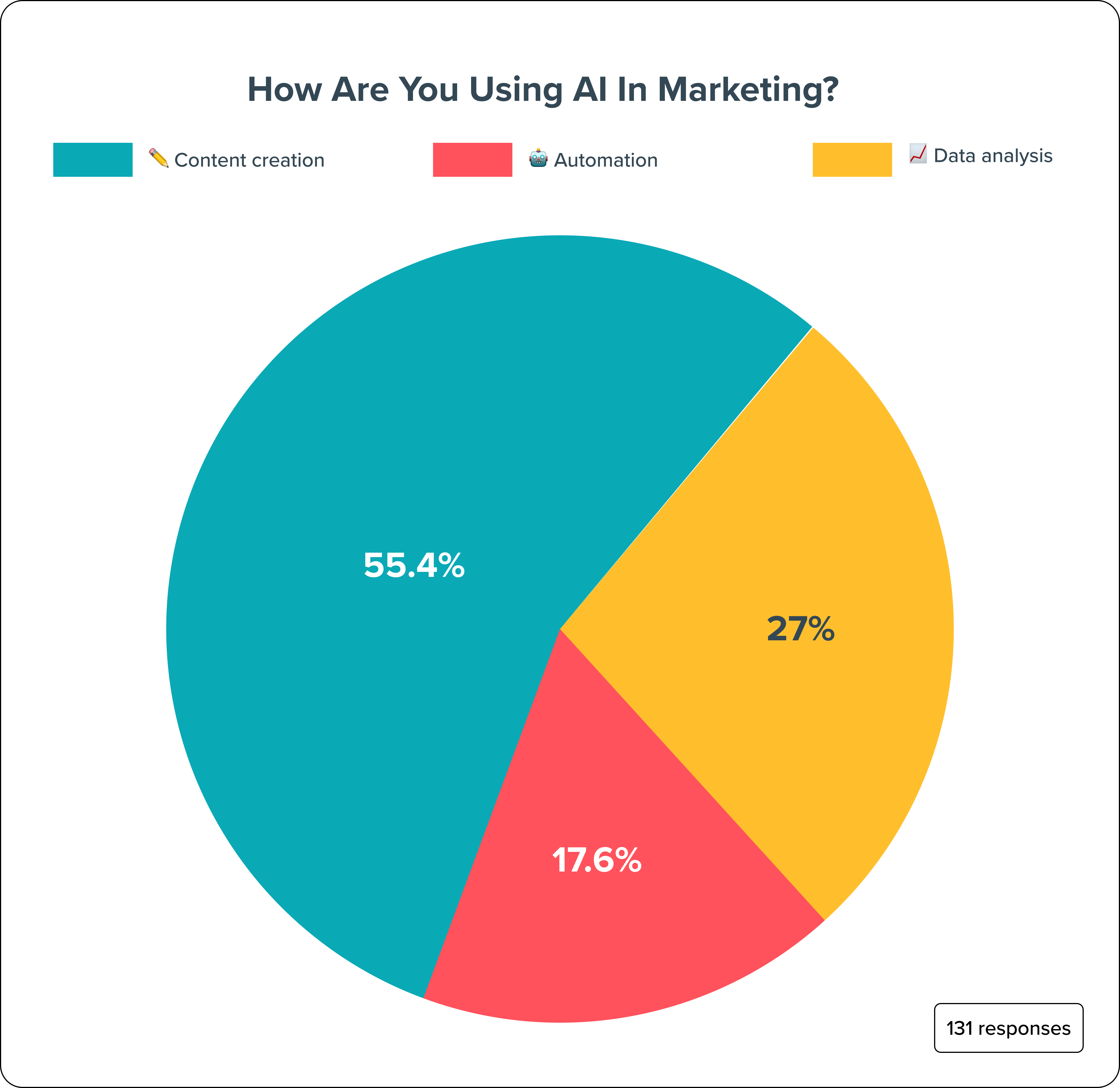
We’ll go more in-depth into what specific content creation tasks marketers are using AI for later in our series. (Teaser: “Generating website copy” isn’t particularly high on that list.) What we’re going to focus on here are the benefits.
Speed appears to be the name of the game, as 55% of respondents said AI has enabled them to complete tasks more quickly. This means marketers can swiftly move on to separate challenges; 46% of respondents said AI allowed them to “do more things.”
This highlights AI’s growing role as a force multiplier of productivity for marketing teams. Clearly, many have discovered how to make clear, measurable workflow improvements with AI.
But Is AI Actually Good?
For some, AI is clearly good at boosting productivity and facilitating faster completion of certain jobs. But what’s the quality of that work? Well, the quality might still be high, but only with human oversight.
Only 24% said AI has helped them improve the quality of their work. This quote from one respondent is representative of what we found:
“Quality: No. Time: Yes. We use it to summarize documents, which we could do [ourselves], but [AI] does it faster, even though errors are not infrequent. So it’s a good rough draft.”
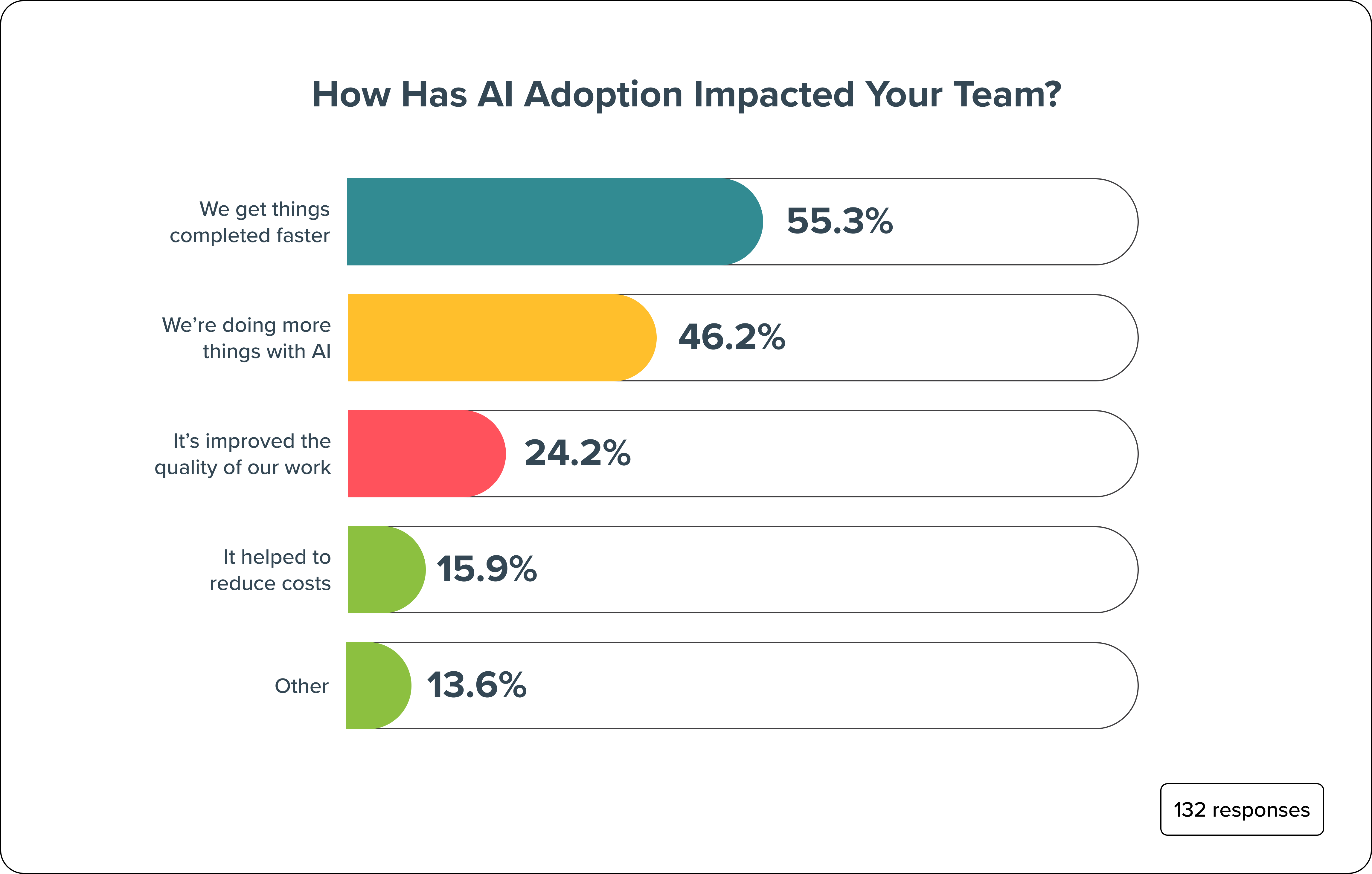
AI tools enable many marketing professionals to work faster and do more. And those who haven’t discovered how to use AI to improve work quality may do so in the future; these are, after all, still relatively new tools for many. However, the fact that only 15.9% have reduced costs with AI suggests that CFOs and financial teams should be discriminating when deciding on AI tools to invest in.
Using AI Cautiously
Given that more than 80% of marketers are using AI, you might be tempted to say the industry has embraced these new technologies. But talk to marketing professionals, and “embrace” doesn’t seem the right word.
People have concerns, and so do marketers. Of course, there are broad questions about AI technology — its environmental impact, matters of privacy, eye-watering valuations of AI companies, etc. — but our survey elicited many marketing-specific issues.
Top AI Concerns
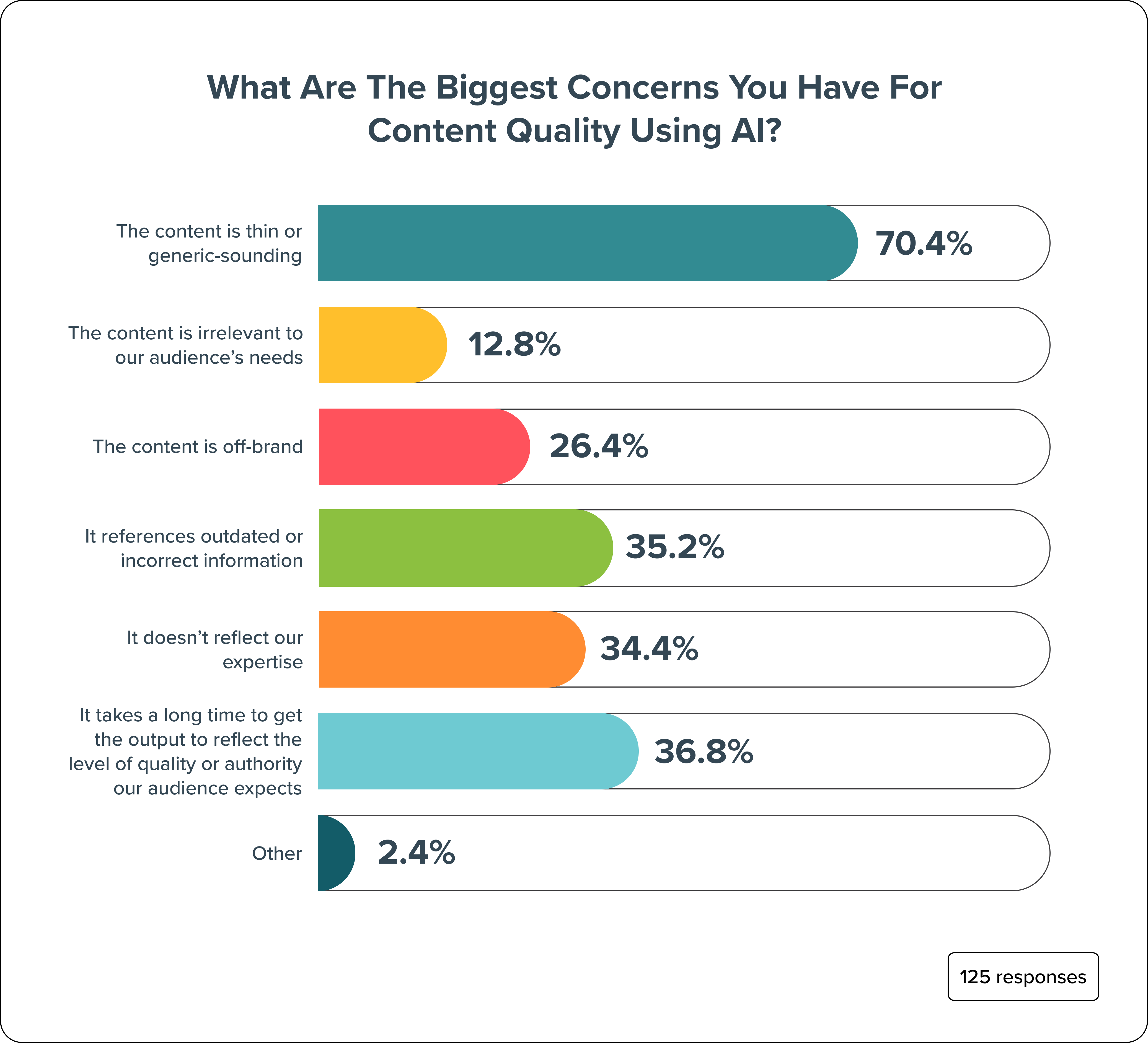
A strong majority of marketers (70%) expressed that thin or generic-sounding content is a major worry. This was by far the most common issue mentioned. So while they’re happy with the efficiency gains, the idea of sacrificing quality or brand reputation was clearly a worrying one.
After questions of content, there’s a wide gap to marketers’ next top concerns. Here’s the breakdown:
One quote stood out: “The landscape will sound increasingly like AI ‘workslop’ until most people develop a distaste for any content that sounds remotely AI-aided.”
So, marketers are definitely using AI, but they’re clearly not entirely happy about it. But they’re also not blithely surrendering their agency over this content.
How Teams Are Handling AI Outputs
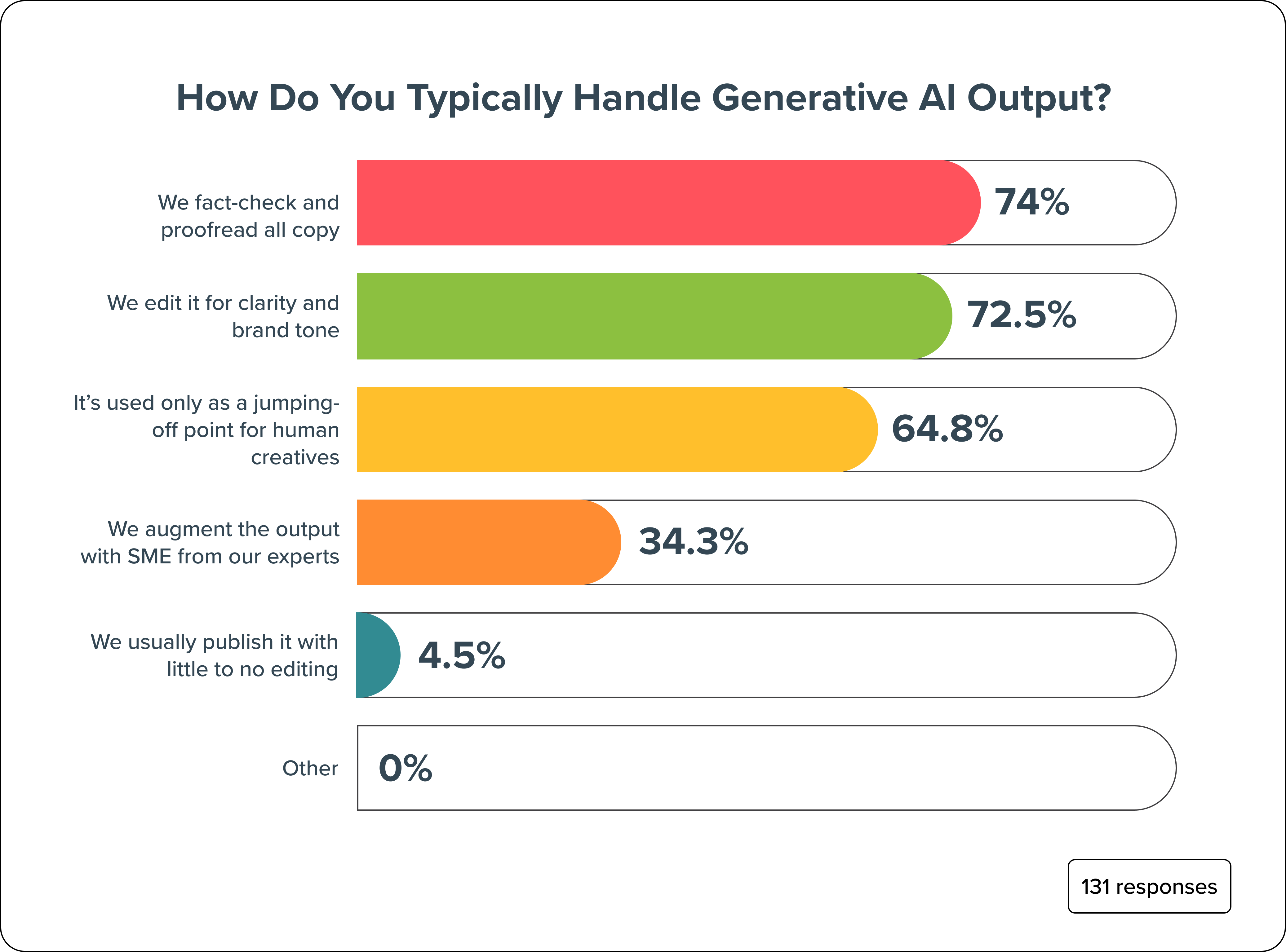
“AI slop” likely refers to content published with little to no oversight. Thankfully, this appears to happen rarely in marketing. Only 4.5% of respondents said they published AI content with minimal or no editing. Using AI for fact-checking and proofreading, revising for tone and clarity and as a jumping-off point in the creative process were the most common uses.
Is AI Worth It?
While using a publicly available large language model (LLM) chatbot to scan a document or draft an outline can save a significant amount of time, marketers are wary of using AI for outputs that their customers or audience might actually see. This is why they almost always work to polish and verify outputs.
But over a third are also unhappy with how long this refinement process takes. So what’s the answer? Is AI limited to providing a slight improvement on certain tasks? Maybe. But perhaps it’s more likely that professionals are still learning to use these tools. Who’s to say that entering better prompts into an LLM won’t result in better outputs? Maybe simply telling the chatbot to use a “professional, B2B tone” could improve content.
Or maybe some teams are using the wrong tool for the job. LLMs are amazing, but they’re not marketing-specific platforms. This might explain why they tend to produce a bland voice, tropes and verbiage that every other LLM and entry-level copywriter relies on. But if professionals used a marketing-specific platform and employed a systematized flow of human checkpoints? Perhaps that would streamline the process of creating on-brand, factually accurate content.
The Skeptic’s Point of View
Some marketers are enthusiastic about AI, some are cautious and others are worried about the long-term ramifications. But even this range of perspectives doesn’t cover everyone in marketing. According to our data, it covers 81%.
The other 19%? This is the group that said they didn’t use AI in marketing in 2025. Most indicated that their companies have never used AI, while a handful (only 5 respondents) reported using an AI tool in the past but decided not to last year. But that doesn’t necessarily mean they’ve all taken a lifelong vow to never use the technology.
Many of these respondents (43%) are simply unsure if they’ll use AI in the near future, while 33% said they have no concrete plans to adopt AI in 2026. Another 23% were more definitive in their intent to refrain from AI this year.
Here were the top four reasons given for not using AI:
- Moral, ethical and/or environmental concerns.
- Data privacy concerns.
- Lack of confidence in the quality of AI output.
- AI tools we’ve seen don’t fit our needs.
One respondent spoke well of the underlying uncertainty and tension surrounding AI right now: “With AI continually plagiarizing work, and including vast amounts of information that it has taken without permission, it becomes quite difficult to use AI in a way that is ethical.”
The tech industry has long championed an ethos of “move fast and break things.” Some have rowed back on this idea, while others remain evangelists. And while this mindset has generated great wealth for a few companies — and has clearly produced impressive tools — it’s only natural that it’s left some folks distrustful of AI and the tech industry.
Whether or not big tech and society as a whole resolve these ethical quandaries, the marketing industry seems confident that AI tools will only grow in importance. We asked, “What’s your outlook on the future of AI adoption in marketing?” Here were the most common responses:
- 59% — Incremental or gradual growth.
- 13% — Cautiously optimistic.
- 11% — AI will continue to support marketers, but not replace them.
AI as the Ally — Not the Enemy
Marketers have not bought into grand claims of AI revolutionizing their industry within a year or two. But they have largely bought into the idea of AI as a fairly useful tool. Given the hype, both positive and negative, surrounding AI, it’s perhaps remarkable that marketing professionals have a largely pragmatic and reasonable position.
As one respondent said, “I want to learn more — I really enjoy the creativity it helps me unlock, but am also nervous about losing my voice or style.”
That’s a great place to end for now, but there’s a lot more to say. Check out our other blogs in this series to delve further into the details of specific AI-related topics.